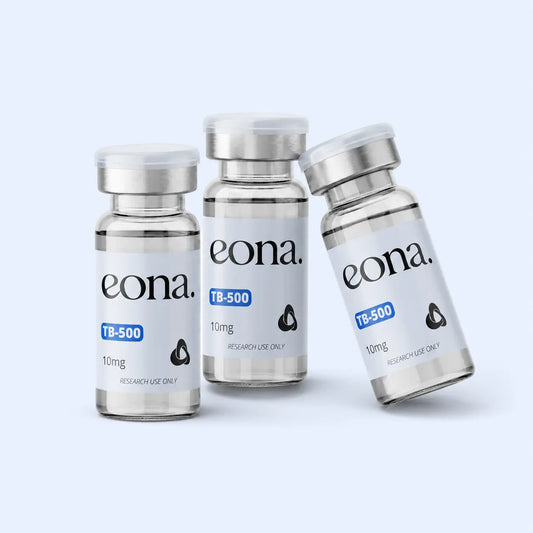
Two verification steps. One batch COA. European origin.
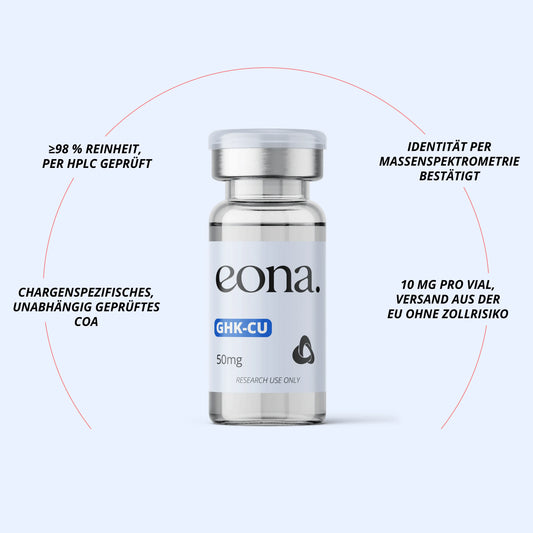
Anyone sourcing verified peptides from Europe for preclinical research needs more than a generic analysis document. The EONA range undergoes a two-step verification process: Each batch is first tested for ≥98% purity by HPLC and for confirmed identity by mass spectrometry. A separate academic counter-verification step independently validates these results from the commercial testing laboratory. The result is a batch-specific COA, which documents both testing stages and can be accessed directly on the respective product page. This methodological transparency distinguishes verified EU goods from imports of unclear origin, whose batch history and analytics are often not traceable.
The range includes preclinically tested substances such as BPC-157, TB-500, GHK-Cu, Epitalon, Semax, and Selank, as well as selected peptide blends. All products are shipped lyophilized from Europe. Volume discounts 1/3/5/10 vials with up to 30% savings. How the two-stage verification per batch works is shown in our verification process. Exclusively for research purposes. Not for human use.
Frequently Asked Questions
How can I tell if a batch COA is genuine and batch-specific?
A batch-specific COA contains a unique batch number, the analysis date, the method used (HPLC with separation conditions and MS for identity confirmation), the measured purity value, and the signature or identifier of the performing laboratory. A generic or undated document without a batch number is not reliable proof. At EONA, the COA for each batch is linked directly on the product page; the academic counter-verification step is documented as a separate test report. Further details are explained in the guide How to read a batch COA correctly.
What is the difference between a commercial batch COA and an additional independent test?
The commercial contract laboratory creates the primary batch COA with HPLC purity value and MS-confirmed identity. An additional academic counter-verification repeats essential analyses with a methodologically and institutionally independent entity, without commercial interest in the result. This second step increases analytical reproducibility and provides an independent corrective to a single testing path. The exact procedure is described in our verification process.
Why is European origin relevant for analytical reproducibility?
European production and analysis conditions are subject to defined regulatory frameworks that include documentation requirements and quality management systems. Peptides from sources of unclear origin often do not offer a traceable batch history or a reproducible analytical procedure. For in-vitro research, where the analytical purity and identity of the starting materials directly influence the reproducibility of results, this is a methodologically relevant difference.
What HPLC purity is considered the standard for preclinical in-vitro work?
In preclinical research practice, an HPLC purity of ≥98% is typically set as the minimum standard for in-vitro assays where impurities could influence biological test results. All EONA batches are tested against this threshold. The exact measured value is stated in the batch-specific COA.
How are research peptides such as BPC-157, TB-500, or GHK-Cu classified from a regulatory perspective?
These substances are classified as technical research material and are intended exclusively for scientific laboratory use. They are not approved for human application and are offered by EONA solely as such. The relevant competent authority is decisive for classification within a specific national legal framework; EONA does not guarantee the legality of sourcing individual substances in certain jurisdictions.
What distinguishes BPC-157, TB-500, and GHK-Cu in substance class and research context?
BPC-157 is a synthetic pentadecapeptide of 15 amino acids and is studied in preclinical research in the context of tissue and tissue regeneration models. TB-500 is a synthetic fragment of the protein Thymosin Beta-4 and is studied preclinically in the context of cell migration and actin regulation. GHK-Cu is a copper-binding tripeptide (Glycyl-L-Histidyl-L-Lysine) and is studied preclinically in the context of extracellular matrix and skin models. The substances thus differ in amino acid length, structure, and research direction studied. All three are technical research material without approval for human use.
Why does the price of verified EU peptides differ from very cheap sources of unclear origin?
The price reflects the documentation and analysis effort, not just the quantity of the substance. A two-stage verification process consisting of a commercial batch COA (HPLC plus MS-confirmed identity) and a separate academic counter-verification incurs reproducible laboratory costs per batch. Very cheap sources of unclear origin often forgo batch-specific analytics, traceable batch history, and EU shipping routes. For reproducible in-vitro work, the reliable characterization of starting materials is a methodological factor that is reflected in the price.
How do I store lyophilized research material to preserve analytical purity?
Lyophilized peptides should be stored in the unopened original vial dry, protected from light, and at -20 °C. Temperature fluctuations and humidity accelerate the degradation of the primary structure and can measurably reduce HPLC purity. The exact storage conditions are specified on the COA and the product label and apply exclusively to the analytical laboratory context.
Further reading: Research Peptides Full Range, Recognizing Reputable Peptide Providers, and How to Read a Batch COA Correctly. The two-stage verification is explained in detail in our Verification Process.
For research purposes only.