Research Peptides in the Regeneration Cluster, Double-Verified from Europe
This cluster includes the peptides most intensively studied in preclinical research in the context of cellular migration processes and tissue morphology: BPC-157 10mg, TB-500 10mg, and the combined BPC-157 + TB-500 Blend. Thymosin Alpha-1 and KPV, as further preclinically researched substance classes, are also available.
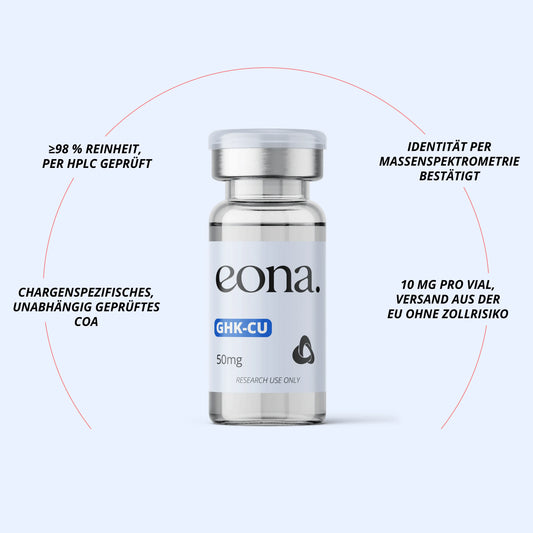
Each batch meets an HPLC purity of at least 98% and mass spectrometrically confirmed identity. The batch COA can be accessed directly on the respective product page. In addition to commercial laboratory analysis, each batch undergoes an independent academic cross-check, so that purity and identity are substantiated by two independent sources. Storage and shipping are from Europe, which reduces customs risk and delivery time compared to non-EU providers. For research series, a quantity discount is available with 1, 3, 5, or 10 vials with up to 30% price reduction.
All products in this cluster are exclusively intended for use in preclinical, in-vitro, or in-vivo research environments. For research purposes only.
Frequently Asked Questions
What minimum HPLC purity should research peptides like BPC-157 and TB-500 have?
For reproducible preclinical results, the literature cites an HPLC purity of at least 98% as the minimum standard. All batches at EONA Peptides are tested against this threshold, and the corresponding chromatograms are documented in the batch COA.
How do I recognize a reputable batch COA, and what information must it contain?
A valid batch COA for research peptides must contain at least: the unique batch number, the results of the HPLC analysis with peak area and calculated purity (%), the result of the mass spectrometric identity confirmation (measured vs. theoretical molecular weight), as well as the date and issuing laboratory. Information without a batch number or without MS data should be considered incomplete. Our guide Reading and Evaluating a Peptide COA explains how to fully interpret a COA.
Why is HPLC alone not sufficient, and how does mass spectrometry confirm identity?
HPLC measures purity based on retention times and area percentages but cannot necessarily distinguish structurally similar impurities with the same retention time. Mass spectrometry determines the exact molecular weight, thereby independently confirming that the compound present has the correct empirical formula. Only the combination of both methods provides a complete identity and purity verification.
Is the acquisition of BPC-157 and TB-500 in Germany permissible for research purposes?
BPC-157 and TB-500 are not approved medicinal products and do not fall under the Narcotics Act in Germany. Acquisition for legitimate preclinical research purposes is generally permissible, but it is the responsibility of the acquiring institution or person to independently check the respective national regulations and institutional approvals. EONA Peptides exclusively supplies individuals and institutions that procure the products for research purposes. All products are not intended for human use.
How should lyophilized research material such as BPC-157 or TB-500 be properly stored?
Lyophilized peptides should be stored unopened at 2–8 °C (refrigerator), dry, and protected from light. For long-term storage over several months, expert literature recommends -20 °C. Moisture ingress and temperature changes should be avoided, as they can impair the integrity of the lyophilized product.
What is a BPC-157 + TB-500 Blend, and how does it differ substantially from the individual compounds?
A BPC-157 + TB-500 Blend is a combination of both individual peptides in one vial; it is not a new chemical compound, but rather the combination of two separately characterized sequences. Substantially, BPC-157 (pentadecapeptide) and TB-500 (Thymosin-Beta-4 fragment) remain unchanged. For the blend, both components are individually analyzed by HPLC and mass spectrometry, and the batch COA lists the respective values separately. In preclinical research, a blend allows for the parallel consideration of both sequences under identical experimental conditions.
What are the differences between BPC-157, TB-500, Thymosin Alpha-1, and KPV as substance classes?
BPC-157 (Body Protection Compound) is a synthetic pentadecapeptide studied in preclinical trials in the context of cellular migration processes. TB-500 is a synthetic fragment of the endogenous protein Thymosin Beta-4 and is investigated in in-vivo research on cell motility and actin dynamics. Thymosin Alpha-1 is a peptide from the thymosin family used in basic immunological research. KPV is a tripeptide (Lysine-Proline-Valine) and a C-terminal fragment of Alpha-MSH, which is studied in basic cellular research. All four belong to different substance classes and address various molecular mechanisms in preclinical research.
Does EONA Peptides ship from the EU, and are the batches independently academically cross-checked?
Yes. Storage and shipping are from Europe, which reduces customs risk and delivery time compared to non-EU providers. In addition to commercial batch analysis, each batch undergoes an independent academic cross-check, so that identity and purity are substantiated by two independent sources. The batch COA can be accessed directly on the respective product page.
Further information: verified peptides from Europe, Reading and evaluating a peptide COA and recognizing reputable peptide suppliers.