Research Blends: Multiple Peptides in One Verified Vial
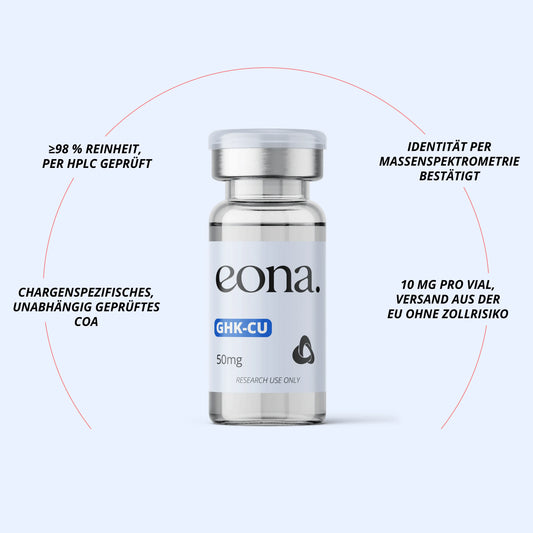
EONA Peptide Blends are pre-mixed research reagents where multiple peptides are co-lyophilized in a single vial. Each blend batch is verified in two stages: by the manufacturer's commercial batch COA (HPLC, purity ≥98% per component) and by an independent academic cross-check using mass spectrometry for identity confirmation. This reduces handling steps in the laboratory and allows researchers to directly compare the price per mg against individual peptides.
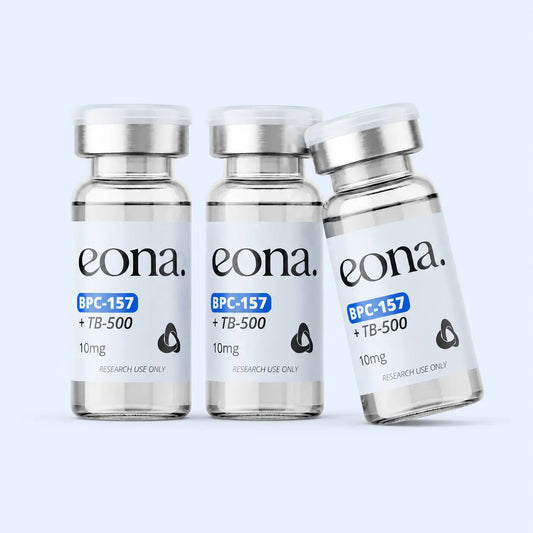
The range includes the BPC-157 + TB-500 Blend, the CJC-1295 + Ipamorelin Blend, the Glow Blend (BPC-157, TB-500, and GHK-Cu in one vial), and the KLOW Blend (BPC-157, TB-500, GHK-Cu, and KPV). All blends are shipped from an EU warehouse. Volume discounts for 1/3/5/10 vials with up to -30% are available. All products are intended exclusively for preclinical research.
Frequently Asked Questions
What exactly is a peptide blend and which compounds are included per vial?
A blend is a pre-mixed lyophilized powder that combines two or more peptides in defined mg proportions per vial. Composition of EONA-Blends: BPC-157 + TB-500 Blend, CJC-1295 + Ipamorelin Blend, Glow Blend (BPC-157, TB-500, and GHK-Cu) as well as KLOW Blend (BPC-157, TB-500, GHK-Cu, and KPV). The exact mg ratio per component is product and batch-specific and is stated on the respective product page and in the batch COA.
Is there a batch COA for each blend, and how is purity ensured in a mixture?
Each blend batch is documented in two stages: The manufacturer's commercial batch COA indicates the purity of each contained peptide component by HPLC (≥98%). Additionally, an independent academic cross-check is performed using mass spectrometry to confirm the identity of the mixture. Both documents are batch-specific and can be accessed for the vial. Background information on COA analysis can be found in the guide How to Read a Batch COA.
What is the difference between Glow Blend and KLOW Blend?
Glow Blend contains three peptides: BPC-157, TB-500, and GHK-Cu. KLOW Blend contains the same three compounds plus KPV as a fourth component. Both blends are sold as research reagents. Information on effects, indications, or human application is not provided.
Is the purchase of peptide blends legal in Germany and the EU if they are declared as research reagents?
Peptides can be purchased as research chemicals in the EU, provided they are not marketed as medicinal products and are exclusively intended for preclinical in-vitro or laboratory research. EONA products are declared as research reagents and are not intended for human use. For binding legal advice on specific use in your own laboratory, we recommend checking with a legal advisor. Further guidance is provided in the guide Recognizing Reputable Peptide Providers.
How are lyophilized blend vials stored as research material?
Lyophilized peptide blends are stable as a dry powder and should be stored cool (2–8 °C recommended), dry, and protected from light. Exact storage conditions and shelf life information are stated on the batch COA and product data sheet.
What price-per-mg advantage do blends offer compared to purchasing individual components?
Since multiple peptides are combined in one vial, blends generally reduce the price per mg of the total peptide amount compared to purchasing all contained compounds individually. The volume discount (1/3/5/10 vials, up to -30%) can further increase the cost advantage. The exact calculation is possible for each blend on the product page.
More verified research peptides from Europe: Verified Peptides from Europe. Single substances for regeneration research: Regeneration.