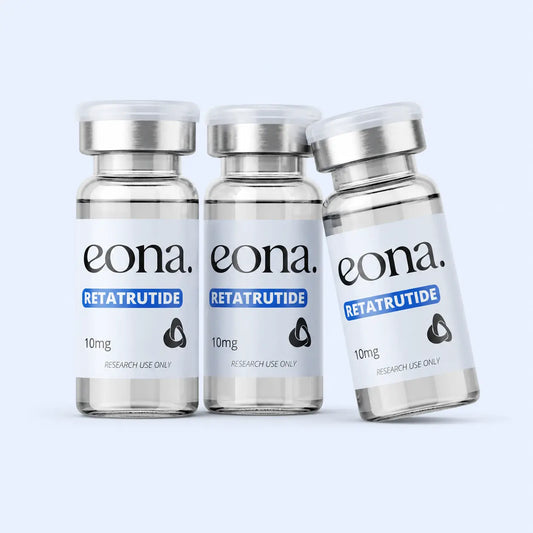
Buy Peptides with Double Verification and Open Batch COA
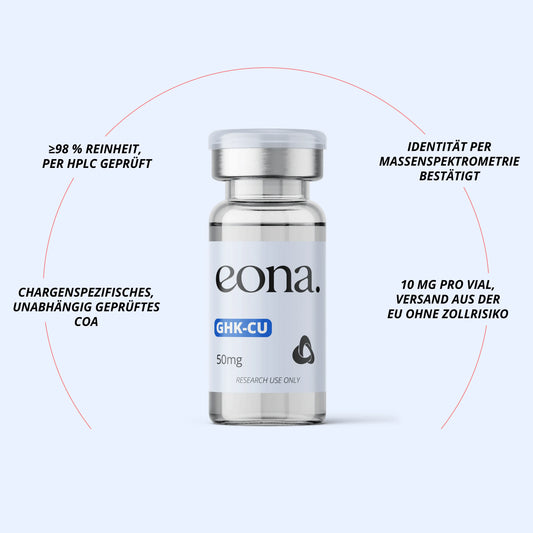
EONA provides research peptides exclusively for documented laboratory purposes. Each batch first undergoes accredited HPLC and MS analysis with a purity of at least 98%, followed by an independent academic cross-check before any vial is shipped. The batch COA is publicly accessible without purchase obligation or login. Shipping is from an EU warehouse: no customs risk, short delivery times within DACH (Germany, Austria, Switzerland).
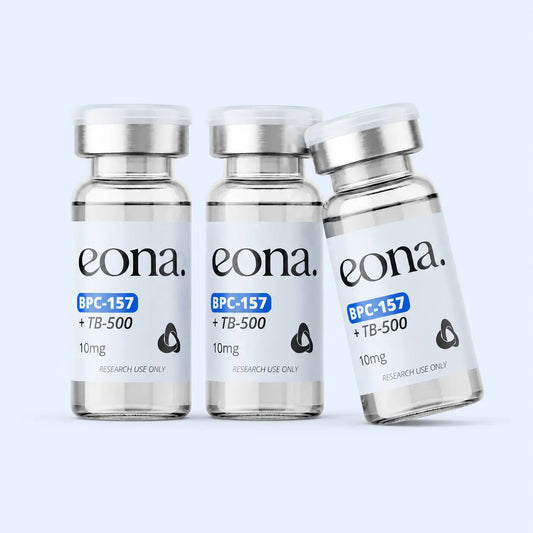
The catalog includes the most important substance classes for preclinical research: regeneration peptides like BPC-157 and TB-500, longevity compounds like Epitalon and GHK-Cu, cognitive research substances like Semax and Selank, as well as optimized peptide blends. Navigation by cluster (Regeneration Peptides, Longevity Peptides, Cognition, Metabolism, Hormone Balance, and Blends) reduces research effort. Volume discounts for 1, 3, 5, and 10 vials allow for up to 30% savings for larger research budgets. All products are for research purposes only.
Frequently Asked Questions
What is the minimum HPLC purity a research peptide should have?
In practice, an HPLC purity value of ≥98% is considered the minimum threshold for documented research material. Values below this indicate by-products or synthesis residues, which can distort analysis results. EONA provides the HPLC-measured purity value for each batch in the publicly accessible COA.
What does a reputable batch COA for peptides contain and where can I find it?
A complete batch COA must show at least: exact peptide sequence, batch number, HPLC purity (with chromatogram), mass spectrometric identity confirmation (MS), and the issuing laboratory with accreditation proof. At EONA, the COA for each batch is available without purchase obligation and without registration via the respective product page. More on this in the guide How to Read a COA Correctly.
Is the purchase of research peptides permissible in Germany?
Research peptides without approved indication and without human determination do not fall under the German Medicines Act (AMG), provided they are obtained and used exclusively as research materials. However, acquisition for human use or transfer as a medicinal product would not be permissible. EONA sells exclusively for research purposes: a clearly communicated research-only framing is equally relevant for buyers and suppliers.
What is the difference between BPC-157, TB-500, GHK-Cu, and Epitalon?
The four compounds belong to different substance classes. BPC-157 is a synthetic pentadecapeptide (15 amino acids) and is being investigated in preclinical research in the context of tissue regeneration. TB-500 is a synthetic fragment of the endogenous protein Thymosin beta-4 and is also a subject of preclinical regeneration research. GHK-Cu is a copper tripeptide (Glycyl-Histidyl-Lysine plus copper ion) and is being researched in the longevity context. Epitalon is a synthetic tetrapeptide (Ala-Glu-Asp-Gly) that is being investigated in preclinical longevity research. All information refers to technical classifications, not statements about human application.
Why is an independent academic cross-check more meaningful than a pure manufacturer COA?
A manufacturer's COA is issued by the producing laboratory itself: economic interests and sample selection are in one hand. An independent cross-check by an academic institution without a supplier relationship confirms or refutes the manufacturer's analysis based on its own sample measurement. If both tests agree, the probability of incorrect values or targeted manipulation is significantly lower. All EONA batches undergo this two-stage process.
How do I store research peptides to avoid degradation?
Lyophilized (freeze-dried) peptides are generally stable if stored dry, protected from light, and at consistently low temperatures. As a guide: short-term storage at 4 °C, long-term storage at -20 °C or colder, protection from moisture and UV light, and avoidance of frequent thaw-freeze cycles. Refer to the product-specific COA for exact storage parameters.
How do I identify unscrupulous providers of research peptides?
The depth of documentation is crucial. Warning signs include: no batch-specific COA (only a generic example or none at all), a COA without an HPLC chromatogram, missing mass spectrometric identity confirmation, and a purity value that is merely asserted but not supported by an inspectable test report. A lack of independent cross-checking and opaque origin are also indicators. A fully viewable batch COA without purchase obligation is the quickest litmus test, more on this in the guide How to Identify Reputable Peptide Providers.
Are larger purchase quantities worthwhile and how is the volume discount structured?
EONA offers vial bundles in sizes 1, 3, 5, and 10 vials. From 3 vials onwards, a price reduction applies, which can be up to 30% below the single price for 10 vials. For research projects with planned series experiments, larger purchases from a single batch are advantageous, as batch variability between different order times is avoided.
Further information on the verification process and origin: Verified Peptides from Europe. All products are for research purposes only.